4 Cs of a Diamond
Anatomy of a Diamond
This section assists anyone with a basic run-down on the 4 Cs of a Diamond

4 C's of Diamonds
Diamond Carat Weight
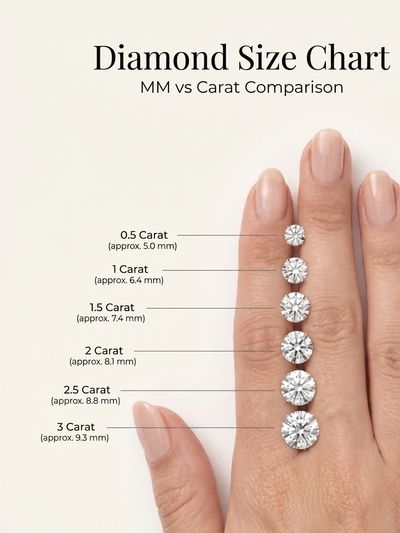
Diamond carat weight is one of the 4C’s that has the highest impact on value. Carat is the unit of weight measurement used specially to weigh diamonds and gems. One carat equals 200 milligrams and if measured in points, one carat is 100 points. So ¼ carat diamond is called 25 pointers, ½ carat diamond is called 50-point diamond and so on.
Even though Diamond carat weight is actually a measurement of weight, it sometimes gets confused with the visual size. Depending upon the shape of the diamond, the stone will visually show different. Carat weight is measured by the distance across the top of a diamond in mm and therefore one carat diamond of a particular shape may look bigger than the same size of a different shape.
The larger diamonds are rare than the smaller diamonds. So if other C’s are equal then a single one carat diamond would cost more than four ¼ carat diamonds. The value of a diamond depends on all 4 C’s of a diamond so the bigger is not always better.
4 C's of Diamonds
Diamond Color
Diamond color actually means the absence of color in a diamond. The closer the diamond is to colorless, the more uncommon it is. Colors in diamonds are due to the different elements available while the diamond was formed.
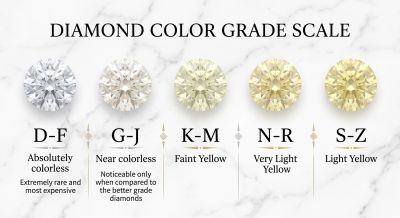
The standard color of a diamond is created by the Gemological institute of America. The color scale ranges from D to Z. Each letter is a measure of how noticeable the color is. The D grade diamond is completely colorless and the Z grade diamond has a tint of yellow. Fancy colored diamonds are the ones that have color outside this color range. Diamonds with less color allow light to pass that makes the diamonds more brilliant.
The split up of the diamond is as shown in the Color Grade Chart.
Diamond color affects the price most after the carat weight. And not everyone is color sensitive and for them, color is one of the 4C’s to compromise on when choosing a diamond and save a lot of money without sacrificing the appearance. Diamonds may reflect the colors around them so many people would prefer near colorless diamonds over colorless diamonds when they have a setting of yellow gold or rose gold.
4 C's of Diamonds
Diamond Clarity
Diamond clarity is all about the inclusions and blemishes. When the diamonds are formed deep in the earth, carbon is exposed to tremendous amounts of pressure and heat. This process leads to the internal characteristics called inclusions and external characteristics called blemishes. Diamonds with no or the less inclusions are considered rare and cost more than the diamonds with high inclusions.
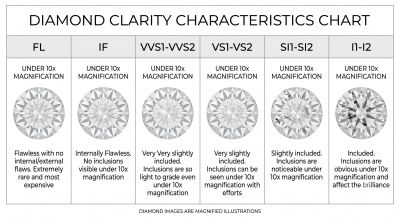
Diamond clarity is classified as FL, IF, VVS, VS, SI, or I. The gemologists use 10x magnification to classify the clarity.
Some inclusions are so tiny that can not be seen by anyone but the trained diamond grader. So VS2 and SI1 may look the same with the naked eyes but they are very different in terms of quality. The diamond clarity is also affected by other diamond qualities. In step cut shapes like emerald or asscher, the open table would make the inclusion more easily visible. Same way, the larger diamonds make them more noticeable due to larger facets. Diamond clarity is the matter of personal preference.
Diamond Clarity Characteristics $
4 C's of Diamonds
Diamond Cut
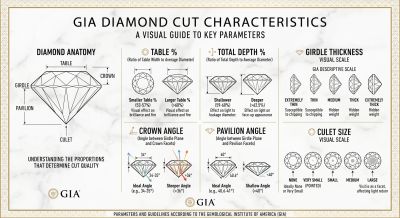
Diamond cut does not refer to the shape of the diamond (Round, Princess, Emerald, Marquise, Pear, etc) but refers to the symmetry and proportion achieved by the diamond cutter. The better the diamond cut, the greater the diamond’s ability to reflect light. Diamonds are valuable for their ability to sparkle bright by transmitting light.
The diamond cut ranges from an ideal cut to a poor cut. The greatest possible light would reflect in the ideal cut diamond and create the sparkle. If the diamond is cut too shallowly, light escapes from the bottom and that makes the diamond look dull and lifeless. If the diamond is cut too deeply, the light would escape from the sides which makes the diamond lose the brilliance. Such diamonds are called poor cut diamonds.
Among all 4C’s, the diamond cut is the most difficult and complex to analyze. To evaluate the cut of the diamond, one needs to study how brilliantly the diamond interacts with lights to create the reflection.
Our Partners
